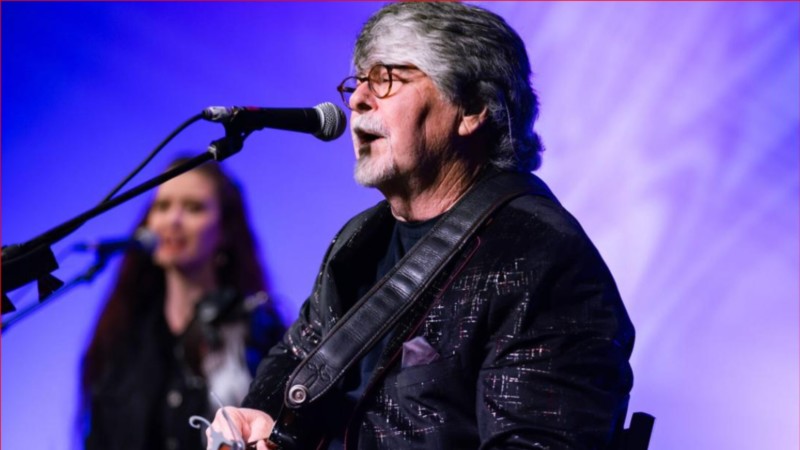
I REMEMBER RANDY
I first met Randy Owen in the early 70's.
I remember Randy—a lanky fellow with jeans so worn they probably had stories of their own. Those denim threads, held together by repairs and dreams, were worn by a young man who possessed more talent than the law ought to allow; yet I didn't know it. On a college campus in the '70s, where everyone was scrambling to find themselves amid the haze of change, Randy didn't stand out like a wildfire in a wheat field. He was just one of us.
You didn't hear his laughter echoing across the quad, or a carefree chuckle that made you feel like everything might just turn out alright. I don't recall a guitar slung over his shoulder or a harmonica peeking out of his back pocket, although now I know Randy was a walking symphony waiting to happen. While most of us were buried in textbooks, trying to decipher Socrates or stumbling through calculus, I do remember knowing Randy found meaning in the strum of a chord and the poetry of untamed lyrics; like everyone knew he wanted to make music.
I don't remember sessions under the old oak tree—me, Randy, and a motley crew of dreamers and drifters. He didn't play until the sun dipped below the horizon, the sky ablaze with colors that seemed to mirror the notes that were yet to flow from his fingers. And deep inside, I never had a premonition there was a yet-to-be—a music that possibly would be written someday that would wrap us all in a cocoon tunes and lyrics that would last for decades to come . Yet, I don't remember thinking it would ever be played.
Now I look back and realize like most of us, Randy wasn't just in college bent on having fun; he was secretly chasing a dream with the kind of reckless optimism that only youth can afford. Behind those spirited eyes, I should have seen there was a hint of something deeper—a quest for purpose, a yearning to understand a world spinning faster than we could keep up with. But Randy was was like an unseen comet blazing across the night sky, brilliant and ignored. He was just another one of us.
Amidst protests and the ever-present buzz of societal upheaval, Randy absorbed day-to-day events and held them sacred; the songs would become the soundtrack of our lives. He captured feelings and the spirit of the times—the confusion, the elation, the defiance—with melodies that would someday resonate
in our very bones. But for all his charisma and the crowds that never flocked to him, I cannot recall moments when he would drift into solitude, gazing into the distance as if searching for answers written in the stars. Randy undoubtedly has set a course for success, and I never realized it.
But now I often wonder about those quiet moments which I do recall around Randy; I discounted it as shyness and intelligence. Did he feel alone in a sea devoid of others like himself? Was the weight of his own expectations a burden he bore silently? It's strange how someone can be a beacon of inspiration
today, yet wrestled with their own brand of loneliness or shyness when they were in their twenties. Maybe it's the curse of the truly gifted, always reaching for a horizon that keeps moving just out of grasp; maybe I just didn't have the ambition or the talent.
Looking back now, I realize Randy was more than just another student shuffling between lecture halls. He had a catalyst—a spark that ignited something in him, alone. His passion was unnoticed, but there had to be a stirring and restlessness to break free from the mold and carve his own path. He must have realized that chasing a dream wasn't just a fanciful notion but an absolute necessity.
Sometimes I catch myself humming a tune that comes from one of Randy's songs, and it all comes rushing back—the camaraderie, the uncertainty, the unbridled joy of that time. It's a reminder that those days shaped us in ways we're still unraveling. Randy epitomized the spirit of an era defined by possibility and fueled by the audacity to hope.
Do you ever think about the Randys of the world? The ones in worn-out jeans with eyes full of wonder, daring to dream a little bigger than the rest of us? It's comforting to imagine they're still out there, perhaps not strumming guitars under starlit skies, but refusing to let the world dim their shine.
Maybe we all have a bit of Randy within us—a flicker of that youthful exuberance, a lingering desire to chase after something more. Perhaps it's never too late to dust off those old dreams, patch up our own worn jeans, and see where the road might lead.
If the good Lord granted me a "do-over" for those times I was around Randy during those years, I'd have made a point to be a little more like him. But then again, none of us—not even Randy himself, I reckon—knew he'd ride his shooting star of a career this far.
Ken Todd
Editor in Chief of The Chanticleer (1971-1972)
Official Campus Newspaper of Jacksonville State University
Randy Owen graduated from Jacksonville State University in 1973 with a degree in English. That same year, he and his cousins were already chasing their dream full-time—laying the foundation for what would become one of the most legendary bands in country music history.